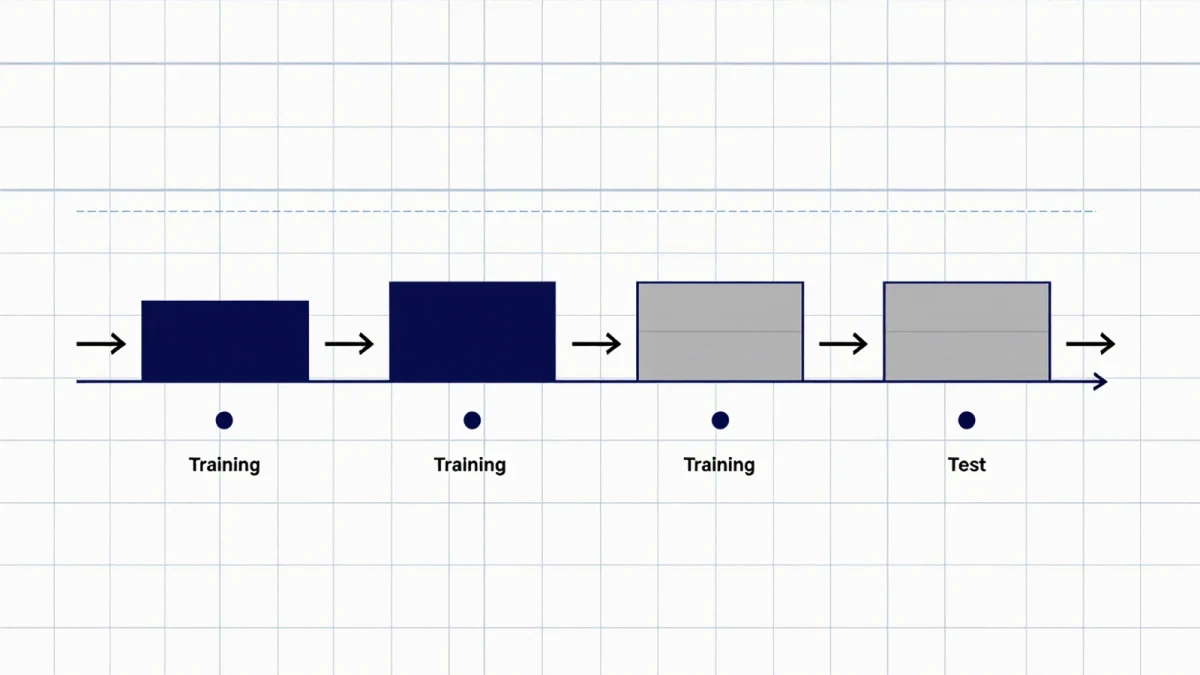
Walk-forward validation splits a historical series into a sequence of rolling windows — parameters fitted on an in-sample stretch, then tested on the immediately following out-of-sample stretch, then rolled forward and repeated — and its measured product is a chain of out-of-sample results stitched together, more realistic than a single split precisely because each segment is tested on data its fit never saw.
Walk-forward is the standard answer to a real problem — one-shot backtests that flatter one parameter choice — and it is also a procedure with its own degrees of freedom: window lengths, refit frequency and anchoring, each of which can be tuned until the method itself becomes the overfitting instrument. This explainer covers what the procedure establishes, what it cannot, and the audit questions that keep it honest.
How does the procedure work?
Fix an in-sample window — say, five years — fit the model or strategy parameters, then evaluate on the next out-of-sample segment — say, one year. Roll the whole apparatus forward by the test length, refit, test again, and continue to the end of the data. The concatenated test segments form the walk-forward equity curve, and the reported statistics — returns, Sharpe ratio, drawdowns — are computed on that stitched series. Anchored variants keep the in-sample start fixed, growing the training window as they roll; rolling variants slide a fixed-width window. The choice changes the question: anchored windows test parameters fitted on everything available at each date; rolling windows test parameters fitted on recent history only.
What does walk-forward fix?
Two documented failure modes of single-split backtests. First, the silent parameter search: a strategy whose lookback was chosen by trying many lookbacks on the whole history reports an in-sample result wearing out-of-sample clothes; walk-forward forces every tested segment to follow its own fit, so parameters cannot have peeked at the future of their test period. Second, regime dependence of the single window: one 60/40 split tests a strategy on one era's regime; a chain of windows samples several regimes, and the stitched result shows whether performance concentrates in one stretch — a concentration that is itself diagnostic, visible in the per-window statistics a proper walk-forward reports.
What doesn't it fix?
Four limits, stated plainly — this is the mandatory limitations section. First, the design itself has dials: window lengths, refit cadence, anchored versus rolling. Trying many configurations and reporting the best chain re-introduces selection bias at the meta-level — the multiple-testing problem moves from the strategy to the procedure, and the correctives are the same: account for the number of configurations tried, or report them all. Second, the windows are still history: a walk-forward chain spanning 2010-2020 tests only the regimes in that decade, and the stitched confidence it produces is conditional on the sample — the same evaluation-window discipline this site applies to any published result. Third, it does not price trading costs, data quality or implementation drift; those layers must be added explicitly. Fourth, and most quietly: walk-forward is often run repeatedly as the researcher iterates — each new idea re-rolls the same history — and the cumulative number of tests across a research program is exactly the quantity the overfitting literature says to count.
How should results be reported?
With the design printed alongside the numbers: in-sample and out-of-sample lengths, refit frequency, anchoring, number of configurations tried, and per-window results — the distribution across windows, not only the aggregate. A walk-forward Sharpe reported without the window design is a statistic with its definition omitted. Comparisons across strategies are honest only at fixed design choices; a strategy tuned per-competitor to the most favorable window is being fitted to its rival, a practice that fails any audit that asks how the design was chosen.
| Design choice | Question it answers | Common abuse |
|---|---|---|
| Window lengths (train/test) | How much history fits, how far ahead is tested | Tuned until the chain looks best |
| Anchored vs rolling | Growing information vs recency-weighted | Switching silently between them |
| Refit cadence | How fast parameters adapt | Cadence chosen per strategy to win |
| Configurations tried | Meta-level search breadth | Never reported — the hidden multiple test |
What is the standing verdict?
Walk-forward is a genuine improvement over single-split reporting, standard in serious quantitative research precisely because it forces a chain of honest tests. It is not a certificate: its own parameters are searchable, its windows are still one history, and its results still need costs and counting. The primary literature on backtest overfitting — the multiple-testing corrections and deflated performance measures developed through the 2010s — applies with full force to walk-forward chains, because the method multiplies the opportunities to test as much as it disciplines any one of them. Readers evaluating a walk-forward claim should ask for the design, the per-window distribution, and the count of everything tried; claims that arrive without those three are backtests with extra steps.