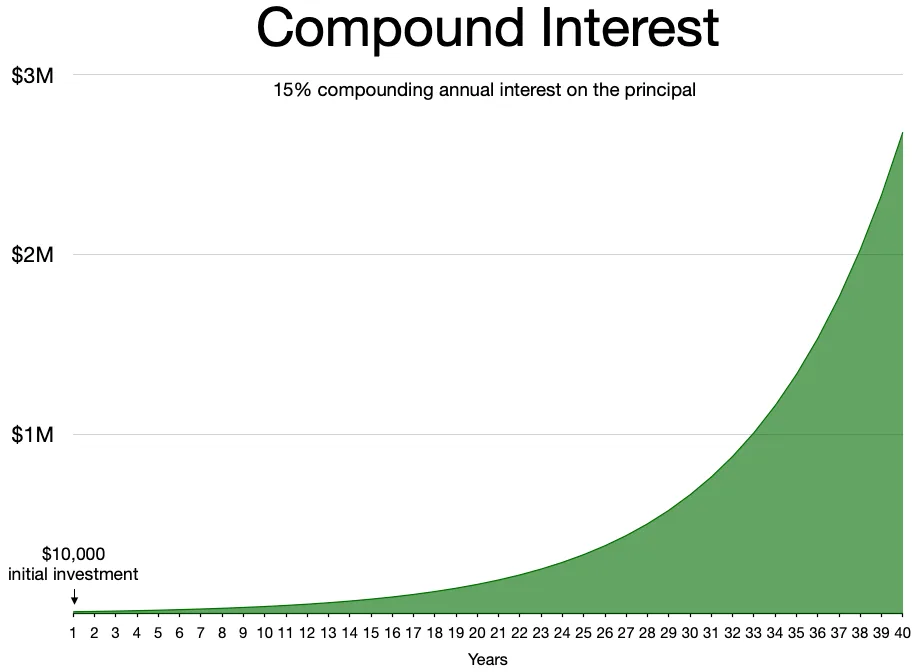
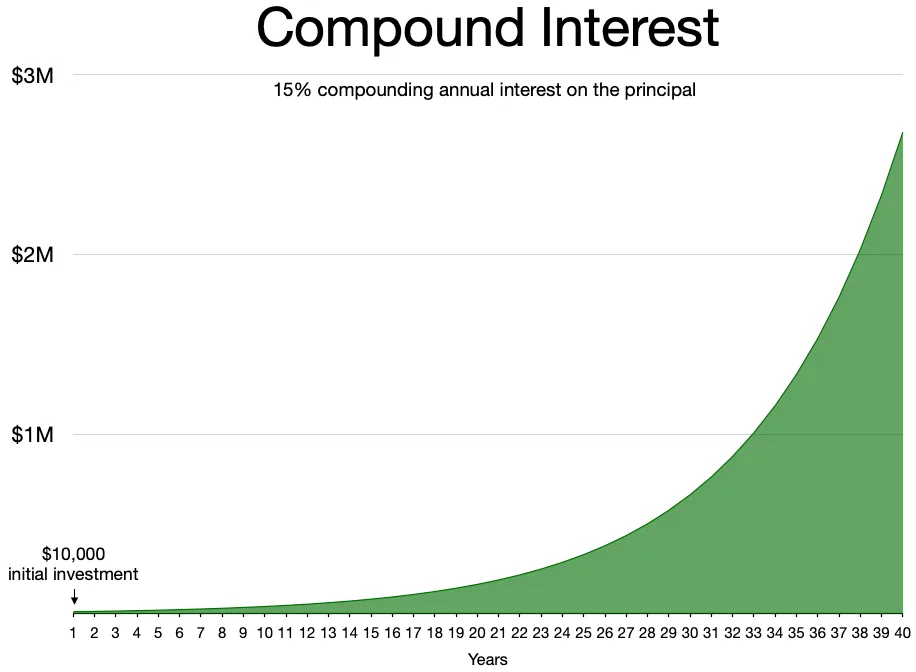
Compound interest has a quiet power: your money earns money, and then that new money earns money too. Over decades, this chain reaction can do most of the work.
The idea is old and well studied. This guide explains how it works, using the standard explanation of compound interest as its ground.
Compound vs Simple Interest
Compound interest is interest accumulated from a principal sum and previously accumulated interest. It is the result of reinvesting or retaining interest that would otherwise be paid out. Simple interest is the contrast. There, previously accumulated interest is not added to the principal amount of the current period.
Compounded interest depends on two things. One is the simple interest rate applied. The other is the frequency at which the interest is compounded. The total compound interest generated is the final amount minus the initial principal. For related coverage, see Dividend yield or total return: which number answers your question?.
A Simple Example
Suppose $1,000 earns 5% interest per year. After 1 year, it will earn $1,050. After 2 years it will be worth $1,102.50. The second year's interest is calculated on a new value, not on the original principal. That small shift is the whole engine of compounding.
Frequency Matters
The compounding frequency is the number of times per given unit of time the accumulated interest is capitalized. It could be yearly, half-yearly, quarterly, monthly, weekly, daily, or continuous. It could also be not at all until maturity. Monthly capitalization with an annual rate means the frequency is 12.
To help consumers compare retail financial products more fairly, many countries require financial institutions to disclose the annual compound interest rate on deposits or advances on a comparable basis. Markets use terms like annual equivalent rate, effective annual rate, or annual percentage yield for it. We covered a connected angle in How many signals were tested before this one worked?.
Where You Meet Compounding
The interest on corporate bonds and government bonds is usually payable twice yearly. The yearly compounded rate is higher than the disclosed rate. U.S. mortgages work differently. They use an amortizing loan, not compound interest. The interest is not added to the principal. It is paid off monthly as the payments are applied.
The Rule of 72
The Rule of 72 is an old shortcut for doubling times. To find the number of years for an investment at compound interest to double, one should divide the interest rate into 72. At 8%, a balance doubles in about 9 years. At 4%, it takes about 18 years.
A Long History
Compound interest was known to ancient civilisations. A clay tablet from Babylon, dating from about 2000 to 1700 B.C., might be the first display of the compound interest problem. Lenders did not always get praise for it. Charging compound interest was once regarded as the worst kind of usury. Roman law and the common laws of many other countries severely condemned it.
The math came later, step by step. In about 1340, the Florentine merchant Francesco Balducci Pegolotti provided a table of compound interest in his book Pratica della mercatura. It gives the interest on 100 lire, for rates from 1% to 8%, for up to 20 years. The Summa de arithmetica of Luca Pacioli, from 1494, gives the Rule of 72. In 1613, Richard Witt's book Arithmeticall Questions was wholly devoted to the subject, with 124 worked examples.
Conclusion: Time Is the Main Ingredient
Compound interest rewards two things: a rate and patience. Each year the base grows, so each gain builds on the last. Short periods show little. Decades show a lot. That is why starting early matters more than picking clever investments. Give the chain reaction time, and reinvest what you earn.
This article is general information, not investment advice. Markets involve risk, including possible loss of principal.