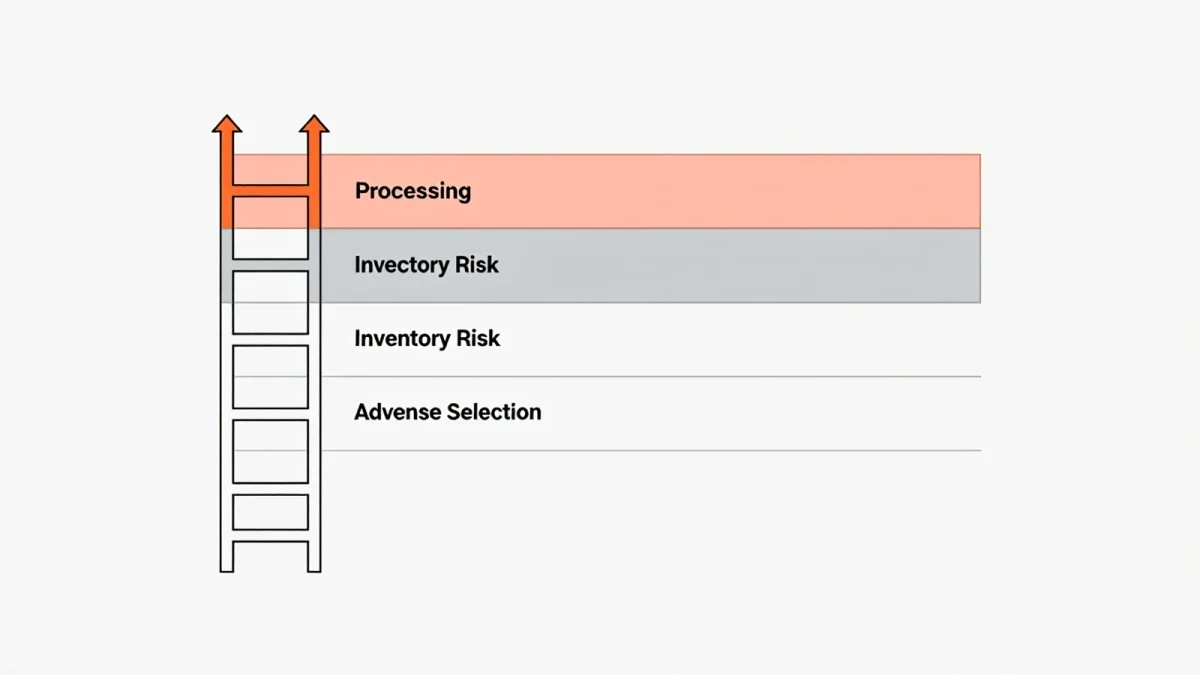
A bid-ask spread decomposes into three economically distinct components — order-processing cost, inventory-carrying risk and adverse-selection risk — and the decomposition, formalized in the market-microstructure literature since George and Venkateswaran's work in the early 1990s, explains why identical stocks quote different spreads and why the same stock's spread multiplies in seconds when news hits.
The spread is the most visible number in markets — quoted on every screen, crossed in every trade — and the least often examined for what it contains. A one-cent spread and a thirty-cent spread are not the same object scaled; they usually have different compositions, which is why they respond differently to the same stress.
What are the three components?
Processing cost is the plumbing bill: exchange fees, connectivity, clearing and the marginal cost of quoting. It is the most stable component, tied to infrastructure rather than information, and it sets the floor under a spread in a perfectly calm, information-free market. Inventory risk is the cost of holding the position a quote implies: a market maker who buys from a seller now holds shares whose price can move before they are resold, and the spread charges for that exposure. Adverse-selection risk is the cost of trading against someone who knows more: if some counterparties trade on information, the market maker systematically buys before falls and sells before rises, and the spread widens to recover those expected losses.
The three components are distinguishable empirically. Inventory effects decay as the position is worked off, often within the day; adverse-selection costs concentrate in trades that are followed by price movement; processing costs are flat. Empirical decompositions in the microstructure literature estimate adverse selection as the dominant share of spreads in information-intensive names, with processing costs dominant in the tightest quotes.
Why do spreads widen so fast on news?
Because the components move at different speeds. Processing cost does not change when a headline crosses. Inventory risk rises with volatility — holding stock for a minute during a tariff announcement is not the same risk as holding it in a quiet session. Adverse-selection risk explodes: the probability that the next order comes from someone who has read the news and knows where the price is heading jumps discontinuously. Spreads quote the sum, so they widen within seconds, long before any human reassessment, and they recover as information becomes commonly held — the pattern documented trade-by-trade in event studies of announcement windows.
What did decimalization change?
Before 2001, U.S. stocks quoted in sixteenths — a minimum tick of 6.25 cents. Decimalization, completed in April 2001, cut the minimum to a penny and competition took quoted spreads on large names down to a cent or less, one of the cleanest and most studied market-structure changes on record. Average quoted spreads for liquid stocks fell by roughly a third or more in the academic estimates of the period. What decimalization did not do is eliminate the other components: inventory and adverse-selection costs reappear inside the quoted penny as depth thinned at each level — a trade documented in post-decimalization studies, where narrower spreads came with smaller displayed size. The total cost of trading did not fall one-for-one with the spread; it redistributed between price and quantity.
How do you measure the spread you actually pay?
Two measures matter and they differ. The quoted spread is the displayed difference between best bid and best ask at an instant. The effective spread is twice the signed difference between your execution price and the prevailing midpoint — it captures price improvement, where orders execute inside the quote, and is the standard measure in execution-quality reporting. Effective spreads are systematically smaller than quoted spreads in liquid names because of internalization and price improvement; the gap itself is a documented market-quality statistic, reported in SEC-mandated execution-quality disclosures by brokers and venues.
| Component | What it charges for | Behavior on news | Behavior in calm |
|---|---|---|---|
| Processing | Plumbing and fees | Flat | Sets the floor |
| Inventory risk | Holding the position | Rises with volatility | Small |
| Adverse selection | Trading against information | Jumps in seconds | Dominant in active names |
Where do spread claims mislead?
Three recurring slips. First, quoting the spread without the size: a one-cent spread on a hundred shares and a one-cent spread on ten thousand shares are different economics once depth enters. Second, comparing spreads across decimal and pre-decimal regimes without noting the tick-size change — the 2001 break is a structural discontinuity that ruins naive long-run spread charts. Third, treating the spread as a tax paid to middlemen in full: the processing component is a fee, but the adverse-selection component is a transfer from slower traders to faster ones, which is a different policy conversation — one the SEC's equity market structure filings at sec.gov document in detail.
Read the spread as a price for three services — standing ready, holding risk, and accepting informational disadvantage — priced continuously and visible to the penny. What a spread contains matters more than what it measures, because the contents predict how it will behave on the day the reader finally crosses it.