Factor investing measures return differences between groups of securities sorted on measurable characteristics — size, valuation, momentum, profitability — and the canonical evidence dates to Fama and French's 1992-93 studies, which documented that small-cap and high-book-to-market stocks earned returns the single-factor market model could not explain.
"Factor" is among the most used words in modern investing and among the least often defined. The definitions that matter are procedural: a factor exists when a specific sorting rule, applied to a specific universe over a specific period, produced a specific spread in returns. Every one of those specifics is checkable, and every one of them is routinely omitted in commentary.
How is a factor defined, procedurally?
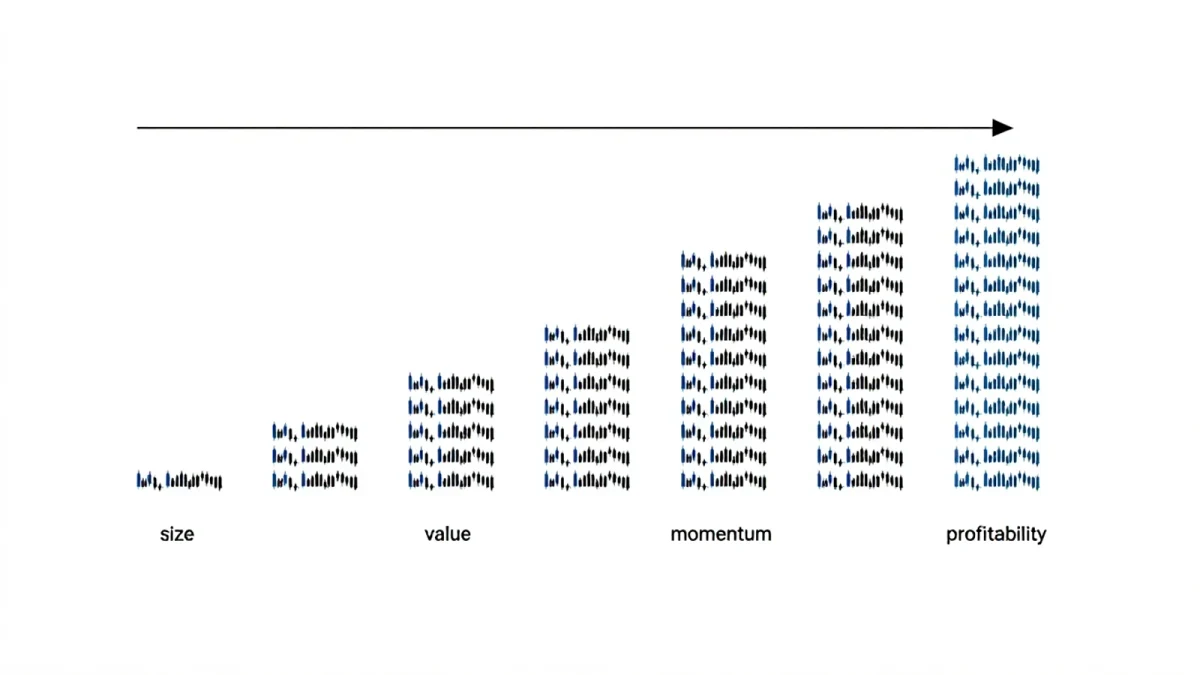
By a portfolio construction rule. Take a universe, rank securities on a characteristic — market capitalization for size, book-to-market for value, trailing 12-month return for momentum, gross profits over assets for profitability — form portfolios of the highest and lowest ranked names, hold for the ranking period, re-rank, and repeat. The factor return is the difference between the high and low portfolios, usually long-short and rebalanced on a schedule. The famous Fama-French three-factor model added size and value to the market factor in 1993; the five-factor extension in 2015 added profitability and investment; momentum, documented by Jegadeesh and Titman in 1993, remains the standard sixth in practitioner work.
The procedure, not the economic story, is what gets tested. A factor is "real" in research terms when the sorted spread is statistically distinguishable from chance across the sample, with the sample period stated — the same discipline this site applies to any forecasting claim.
What is the evidence, and how strong?
The original evidence is long-sample: the Fama-French data, freely published and updated through the Ken French Data Library, runs from 1926 and shows persistent size and value premia over the full twentieth century, with the exact magnitudes depending on construction and period. The caveats are equally documented: premia are not constant, and both size and value experienced multi-year stretches of negative returns even in the historical sample. Momentum shows one of the longest documented premia with some of the worst crash episodes — sharp reversals in 2009 being the canonical case, studied in detail in the momentum-crash literature of the following years.
Why do factor premia exist?
Two families of explanation, both unverifiable directly and both consistent with the data. Risk-based explanations hold that factor returns compensate for bearing some risk — distress risk for value, liquidity risk for small size. Behavioral explanations hold that premia come from predictable errors by other investors — underreaction driving momentum, overreaction correcting into value. The debate matters practically for one reason: risk-based premia should persist under competition, while pure-behavioral premia might decay as they become known. Documented post-publication decay of premia — the tendency for effects to weaken after papers publicize them — is a measured regularity across the published-factor literature, quantified in meta-studies from the mid-2010s.
What do factor funds actually deliver?
Implementation layers real-world frictions between the research factor and any investable product: long-only funds hold the market plus a tilt, not the long-short spread; rebalancing costs and turnover — momentum strategies being turnover-heavy — eat into theoretical returns; and index providers differ on construction, so "value" funds hold visibly different portfolios. The result, documented in fund-versus-index comparisons, is tracking behavior in which product returns diverge from paper factor returns by construction. A fund fact sheet naming a factor has not yet told you which sorting rule it uses — that is in the methodology documents.
| Factor | Sorting variable | Canonical evidence | Documented failure mode |
|---|---|---|---|
| Size | Market capitalization | Fama-French 1992-93 | Multi-year stretches of underperformance |
| Value | Book-to-market and variants | Fama-French 1992-93 | Long droughts, definition-sensitive |
| Momentum | Trailing 12-1 month return | Jegadeesh-Titman 1993 | Sharp reversals, e.g. 2009 |
| Profitability | Gross profits / assets | Novy-Marx 2013; FF5 2015 | Shorter evidence history |
Where does factor talk mislead?
Four recurring failures. First, factor without procedure: a name, not a sorting rule, conveys nothing testable. Second, full-sample worship: a premium measured over 90 years includes regimes its investors may not be able to sit through; state the period, including the bad stretches. Third, cherry-picked windows: any factor can be shown winning or losing on a chosen window, the same evaluation-window discipline this site applies everywhere. Fourth, survivorship of definitions: factor libraries grew to hundreds of published candidates, and multiple-testing corrections — the work of Harvey, Liu and Zhu being prominent — argue that many published factors at conventional significance levels are false discoveries. The replication crisis in factor research is a live research topic, not a settled memory.
How should a reader evaluate a factor claim?
Demand the sorting rule, the universe, the rebalancing schedule, the sample period and the evaluation window, then ask whether the spread survived those conditions stated together. The primary data for the classic factors is public — the Ken French Data Library at Dartmouth — and the Securities and Exchange Commission's investor materials at investor.gov cover how index and factor funds relate to their benchmarks. A factor claim that arrives without its procedure is a story, and stories are not measured.