Robo-advisors rebalance client portfolios by rule — typically calendar checks combined with drift thresholds, with cash-flow reinvestment opportunistically correcting drift before trades are needed — and the honest evaluation of their rebalancing claims is the same evaluation this site applies to any rules-based strategy: what is the rule, on what frequency, at what cost, measured against which baseline.
"We rebalance automatically so you don't have to" is a true statement of mechanism and an incomplete statement of value. The mechanism is checkable in each platform's disclosures. The value — better outcomes per dollar than a self-directed alternative — is an empirical claim that depends on the counterfactual, and the counterfactual is where the arithmetic gets interesting.
What do the platforms actually say they do?
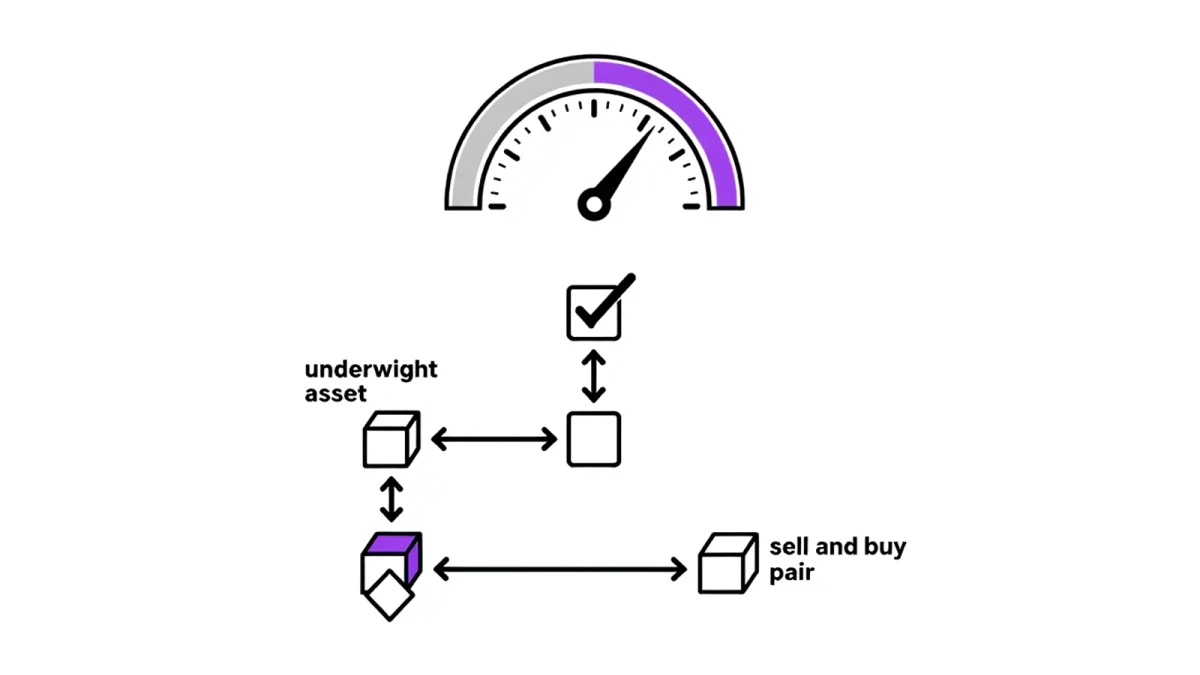
Form ADV brochures and platform documentation describe the mechanics with more precision than the marketing pages: drift thresholds commonly in the 3-to-5-percent band range by asset class, check frequencies daily to quarterly, tax-aware variants that preferentially sell tax lots — tax-loss harvesting being a heavily promoted companion feature — and cash-flow rebalancing that routes deposits into underweight assets. Reading the ADV filing rather than the homepage yields the actual rule, and the filings differ across platforms in ways the homepages blur: threshold widths, whether bands are absolute or relative, and how harvested losses are deployed.
What is the measurable benefit of automated rebalancing?
The benefit has two components of very different evidential strength. The behavioral component is strong: rules execute when humans procrastinate; a documented body of advisor and plan-sponsor research finds disciplined rebalancing is inconsistently performed by self-directed investors, especially after large drawdowns when it is most uncomfortable. The performance component is weak and bounded: as the rebalancing literature shows, the return difference between sensible rebalancing rules is small and path-dependent; the main effect of rebalancing is risk control, not return enhancement. A robo-advisor's rebalancing therefore buys discipline and risk-stability, and any claim beyond that — alpha from rebalancing — contradicts the published simulations.
What does tax-loss harvesting add, measured?
Harvesting realizes losses to offset gains, deferring taxes; its value depends on an investor's tax position, the existence of losses to harvest — which requires volatility — and the wash-sale rule's discipline around replacement securities. Platform-claimed harvesting benefit figures are vendor estimates with stated assumptions; independent academic analyses, including the well-known studies from the mid-2010s that estimated tax-alpha from harvesting strategies, find annual benefits that are positive in their samples but highly variable with volatility, tax rates and turnover. The claims that survive scrutiny carry their conditions: benefit is largest in volatile markets, taxable accounts, high tax brackets, and it is not a constant of nature.
What does the service cost against the counterfactual?
The honest comparison is net. Robo advisory fees have typically run near 0.25 percent annually for the digital tier, on top of underlying fund expenses near those of low-cost index vehicles; a self-directed three-fund portfolio using comparable funds carries the fund expenses without the advisory layer. The advisory layer must therefore be justified by what it measurably adds — behavioral discipline, tax-aware automation, absence of the investor's own errors — against its roughly quarter-percent annual cost. For hands-off investors the behavioral case is real; for investors who would follow a rule anyway, the arithmetic runs the other way. Both conclusions are legitimate; neither is a fact about markets, only about the investor.
| Claim | Evidential standing | What to ask |
|---|---|---|
| Automatic rule-based rebalancing | Mechanism, verifiable in ADV | Thresholds, frequency, bands absolute or relative |
| Improved returns from rebalancing | Weak; simulations show path-dependence | Baseline used, period, cost assumptions |
| Tax-loss harvesting benefit | Vendor estimates; variable in independent studies | Tax-rate assumptions, volatility dependence |
| Low-cost advantage | Compared with human advisors, yes; vs DIY, layer cost | All-in fee: advisory plus fund expenses |
Where do robo claims mislead?
Three patterns recur in the marketing genre. Conflating automation with optimization: executing a rule automatically is not evidence the rule is better than other sensible rules — the rebalancing literature shows the differences are small. Quoting harvesting benefits without the investor's tax position: the same strategy's value ranges from material to zero across brackets and account types. And implied forecasting: any suggestion that the platform's process improves on market returns through its machinery is a performance claim that belongs under the same baseline-discipline lens as any fund's claim — asked and answered with measured windows, not adjectives.
The primary documents are short: the platform's Form ADV, its fee schedule, and its rebalancing methodology page. The Securities and Exchange Commission publishes rob-advisor investor bulletins — its robo-adviser guidance since 2017 is summarized for readers at investor.gov — and standardized fee and performance reporting makes the all-in cost arithmetic directly checkable. Automation is a real service with a measurable price; the claims are exactly as strong as their stated baselines.