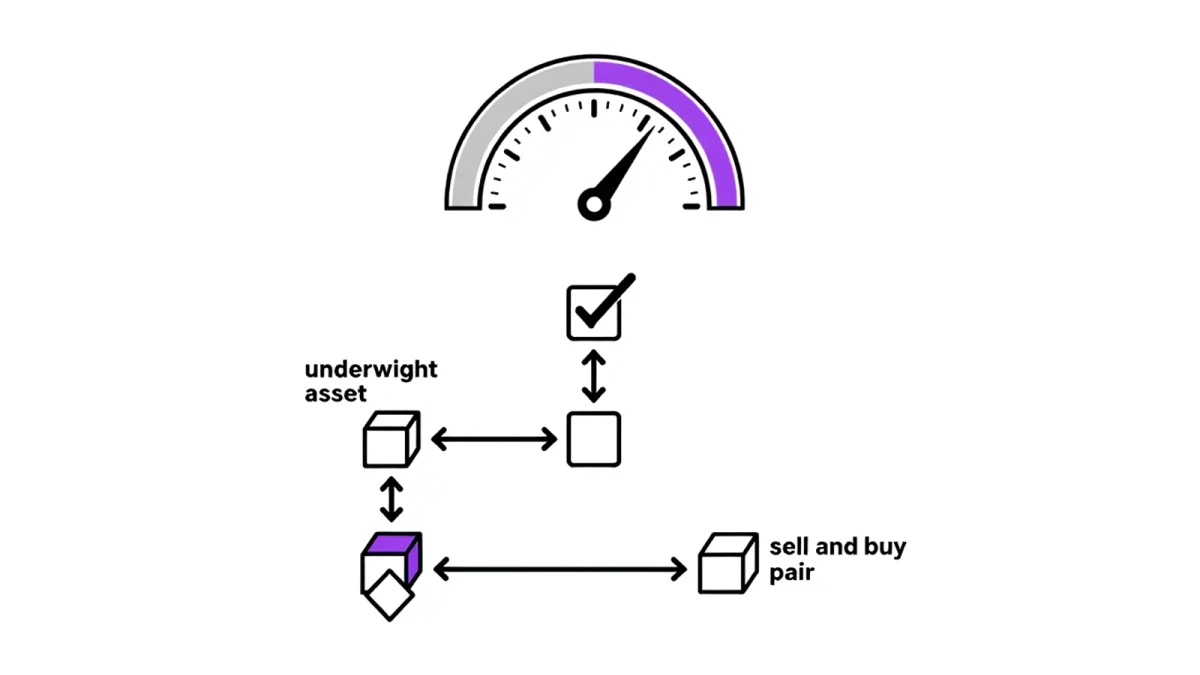
Rebalancing research compares two rule families — calendar rules that trade on a schedule and band-based rules that trade when weights drift past thresholds — and the consistent finding across simulation studies since Daryanani's 2008 work is that both control drift about as well, with band-based rules trading less often at similar or slightly better risk control, and neither rule producing reliable return enhancement.
Rebalancing is a rules question, which makes it unusually tractable: the strategies can be simulated exactly on historical data, with every assumption explicit. That same tractability is where the controversy lives, because the answer depends on the return paths the simulation feeds in — and return paths are the one thing nobody has. What the literature can say precisely is narrower and more useful.
What are the two rule families?
Calendar rules rebalance back to target on a fixed schedule — monthly, quarterly, annual. Band rules specify a tolerance around each target weight — commonly 5 percentage points absolute or 20 to 25 percent relative — and trade only when a holding crosses its band, resetting either to target or to the band edge. Hybrid rules check on a calendar but trade only outside bands. The design tradeoff is mechanical: tighter bands and more frequent calendars control drift harder but trade more, and every trade pays a spread and possibly a tax in taxable accounts.
What did the classic comparisons find?
Daryanani's 2008 study, published in the Journal of Financial Planning, simulated calendar and band rules across 1973-2004 U.S. market paths and found band-based rebalancing captured slightly more of the rebalancing premium with fewer trades than calendar rules, with 20-percent-relative bands among the efficient settings. Vanguard's research arm published widely cited follow-ups reaching a compatible conclusion: monthly, quarterly and annual calendars all controlled risk similarly, with annual-plus-bands flagged as a reasonable cost-conscious default. The magnitudes in all these studies are modest — a few tens of basis points between rules in most periods — and every study states, or should state, its data window, asset menu and cost assumptions, since all three move the answer.
Why doesn't rebalancing reliably add return?
Because rebalancing premium depends on the path. When assets mean-revert, rebalancing sells winners and buys losers and earns a premium for it; when assets trend — one asset rising persistently for years — rebalancing persistently sells the winner and earns less than never trading. U.S. stocks from 1995 to 1999 or 2010 to 2021 were trend regimes where rebalancing reduced returns versus drift; 2000-2002 and 2008-2009 were reversal regimes where it helped. Studies honestly report this asymmetry: rebalancing is a risk-control strategy with path-dependent returns, not a source of free return. The volatility of the funded weight path is what it reliably controls — that is measurable in every simulation without exception.
What do taxes and costs do to the comparison?
They flatten it and often reverse the ordering. In taxable accounts, each rebalance realizes gains; band rules, trading less often, generally realize less. Transaction costs, which dominated the older studies' attention, have shrunk for liquid index vehicles but reappear for illiquid holdings. The practical ranking that survives cost and tax frictions is usually: annual-or-longer checks, with moderately wide bands, trading back to target when triggered — the pattern both Daryanani and the Vanguard analyses converge on from different methods. Any comparison quoting a rebalancing premium without stating costs and tax treatment is describing a frictionless world that does not exist.
| Rule | Trades when | Drift control | Typical finding |
|---|---|---|---|
| Calendar (monthly/quarterly/annual) | On schedule | Good | Similar risk control; more trades |
| Bands (absolute or relative) | Threshold crossed | Good | Fewer trades, similar control |
| Hybrid (calendar check + bands) | Scheduled check finds drift | Good | Cost-conscious default in studies |
| Never rebalance | — | None; weights drift | Path-dependent; risk departs target |
Where do rebalancing claims mislead?
Three overstatements recur. First, the rebalancing premium as a law: it is path-dependent, absent or negative in trend regimes, and honest studies say so. Second, precision about the best band width: the differences between 15 and 25 percent relative bands are within simulation noise across studies — quoting an optimum to the basis point from one sample is overfitting the rule, the same failure mode this site flags in strategy backtests. Third, ignoring the investor's actual situation: account type, tax bracket and holding liquidity change the ranking more than the rule choice does.
What is the honest summary of the evidence?
Both families control drift; bands trade less for similar control; returns differ by path, not by rule; costs and taxes favor less trading; and the choice among sensible rules matters less than adhering to one. Readers wanting the primary comparisons can find Daryanani's study and the Vanguard research papers through their publishers, and the Securities and Exchange Commission's materials at investor.gov for how rebalancing interacts with fund costs. The measured truth of rebalancing is unglamorous: it is a commitment device that keeps risk where it was set, and its study is a lesson in reading simulations with their assumptions attached.