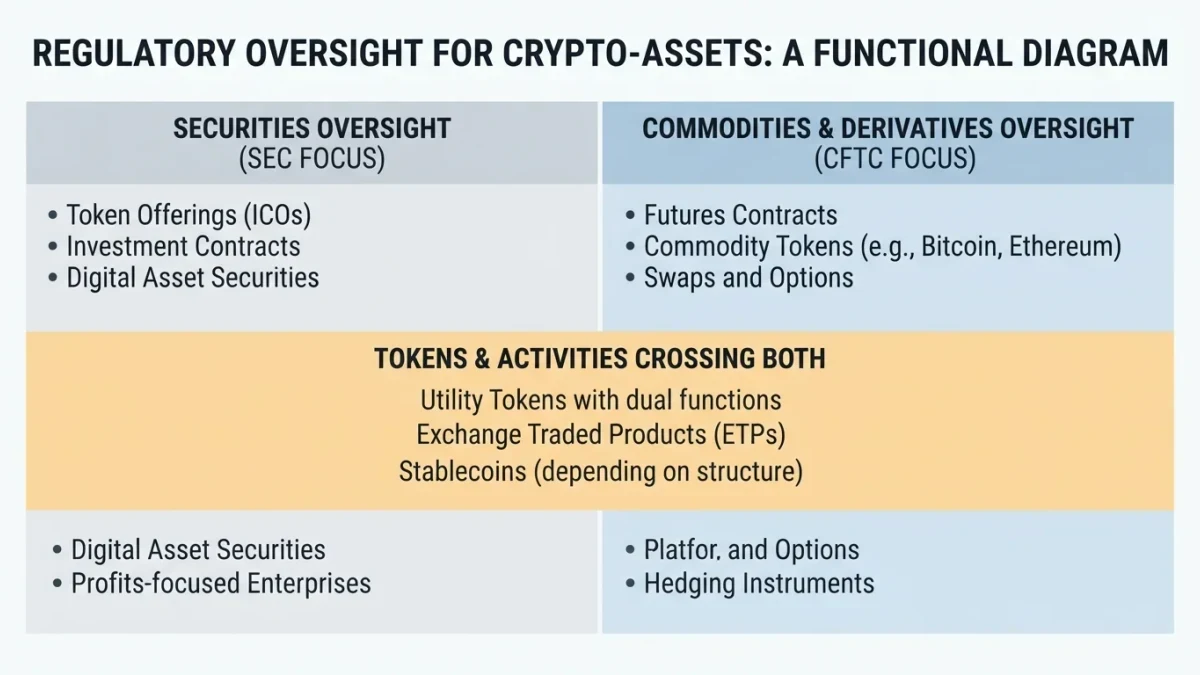

The Securities and Exchange Commission and the Commodity Futures Trading Commission issued a joint interpretive release on March 17, 2026 establishing a five-category taxonomy for how federal securities and commodities laws apply to digital assets, per the release published by the SEC — a coordinated framework that legal analyses describe as capping a decade of shifting SEC policy with a single joint interpretation.
Two regulators jointly defining a classification system is rare, and the rarity is the news: the release replaces years of enforcement-by-litigation positioning with a published taxonomy that market participants can read, apply and contest through ordinary channels. Classification is measurement — categories with criteria — which makes this squarely this site's subject.
What does the release do?
It interprets existing law rather than creating new rules: five categories sorting digital-asset arrangements by their economic function and legal characteristics, with the agencies' respective jurisdictions delineated across the categories. Interpretive releases do not carry the force of rulemaking with notice and comment; they state the agencies' reading of the statutes they administer — securities law on the SEC side, commodity law on the CFTC's — and how that reading sorts the field. The five-part structure follows a period in which both agencies had pursued digital-asset matters through enforcement actions and separate statements, a sequence the joint document now consolidates, as legal commentaries published in the following days summarized.
What is measurable in a taxonomy?
Three things. Coverage: which arrangements fall in which category, stated by criteria a reader can apply to a specific asset's documentation. Boundaries: what the taxonomy does not decide — the release's own limitations section and the categories' edge cases, which interpretive documents typically flag rather than resolve. And process: what happens to a contested classification — interpretation invites case-by-case application, and the agencies' ordinary channels, including no-action and exemptive paths, remain the machinery. What a taxonomy does not do is certify any asset as safe, compliant or worthwhile — a category assignment is a legal reading, not an evaluation, and any claim that an asset "passed" the framework is a marketing sentence.
What is the documented context?
The joint release followed a multi-year sequence: enforcement-led crypto positions through the early 2020s, leadership changes at both agencies, and a formal harmonization initiative under which the two regulators committed to coordinated rulemaking — the initiative's page at sec.gov tracks the sequence, with further items including a June 2026 joint request for comment on portfolio margining and the SEC's 2026 strategic plan elevating digital assets. The March taxonomy is the framework document in that sequence; the release itself is published at sec.gov as release 33-11412, and reading it directly — five categories, criteria, limitations — is the correct primary step this summary cannot replace.